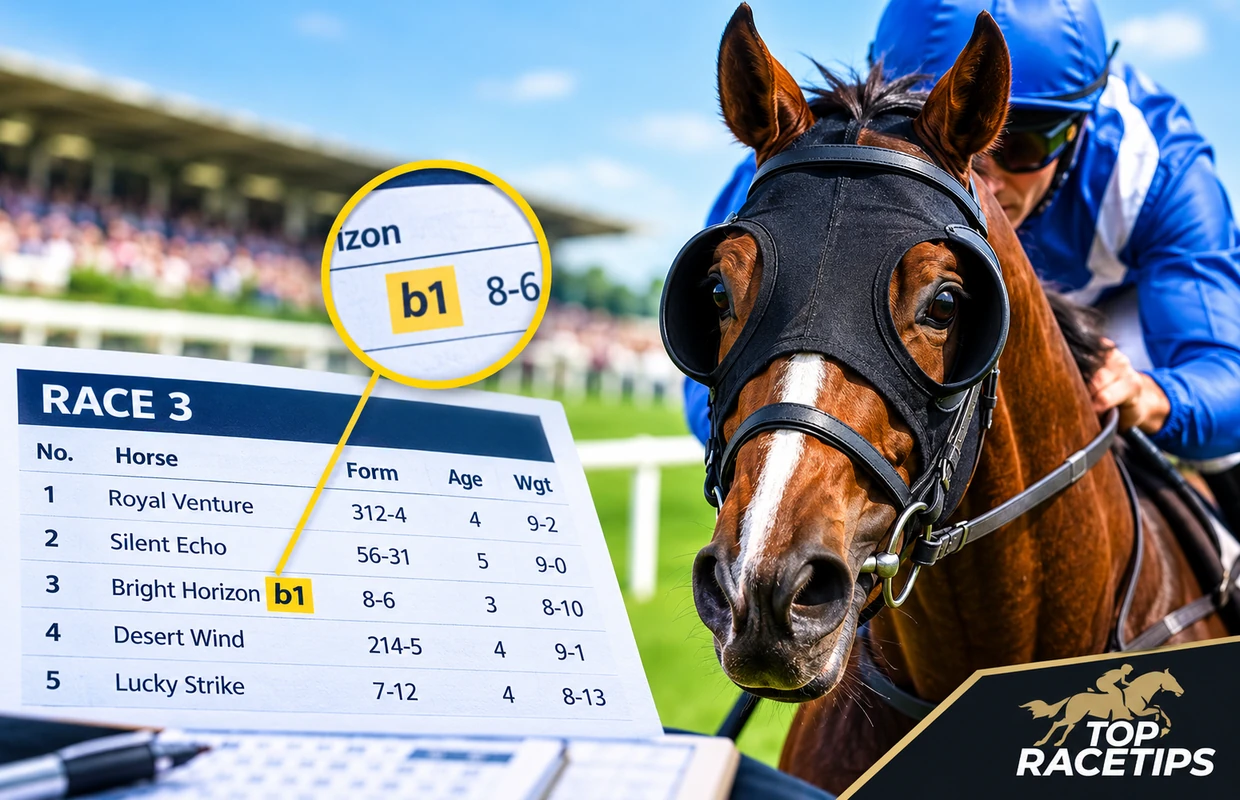
Have you ever seen a small "b1" next to a horse on a racecard? It looks small. But many punters stop and look twice when they see it. This means the horse is wearing blinkers for the first time. Some bookmakers call this the first-time blinkers angle. In this guide, you'll learn what it means, why trainers do it, and how to use it carefully.
Blinkers are small cups placed on either side of the horse's eyes. They are attached to a hood that goes under the bridle. They come in many shapes, sizes and colours.
A horse's eyes are on the sides of its head. This gives it a very broad view of the world. The blinkers block most of the view on that side. The horse can only look forward, at the track ahead. In the United States, blinkers are often called blinders. The idea is the same.
Trainers add blinkers for a big reason. They want the horse to concentrate. A busy racecourse is full of crowds, noise and lots of other horses. Some horses become disoriented. Others become nervous or "frightened."
Blinkers can help the horse stay calm and focus on the race. They can also help young horses who are still learning. Racing writers call these horses "green". The green horse may not know how to run well yet. Blinkers can help it settle down and go straight.
Not every horse needs them. A trainer usually makes this change when the horse seems to have talent but is not showing it.
This part is easy. Look at the racecard. If you see “b1,” the horse is wearing blinkers for the first time. The "b" stands for blinkers. "1" means first time. If you only see a "b", the horse has worn blinkers before.
Several horse racing websites also share daily lists of horses in the blinkers for the first time. Always check for final announcements on race day. Plans may change.
The "angle" is a clue that helps you find a horse that may be better than its odds. Bookmakers are on the lookout for these clues all the time.
Here's the thinking. A horse may have run badly in its last few races. Because of this, its chances may be longer. Then the trainer adds the blinkers. If the horse concentrates better, it can run much better. If this happens, a big-priced winner is possible. This is why some bookmakers follow every horse in first-time blinkers.
Not every trainer gets good results from this change. Some do very well. Others don't.
Many racecards and form guides show how trainers work by turning the blinkers on and off. In North American racing, one guide says any number over 15 per cent is high. Use the trainer's records as a clue. This tells you more than the “b1” symbol alone.
Before you stroke a horse in the first-time blinkers, ask yourself:
Here's something that many people forget. Some sharp punters believe that the biggest jump in form often comes on the second run in the blinkers. By then, the horse has had time to get used to them.
That's why some bettors look at a horse in its first race. Then they look at it again the next time. This can save money if the first run doesn't go well.
Betting should be fun. Only use money you can afford to lose. Set a limit before you start. Never chase your losses. You must be 18 years of age or older to place a bet, and this age may be higher where you live. If betting becomes fun, seek help from a support group near you.
At first, the blinkers angle is a simple tool. This can help you spot horses that can run better than their potential. Learn to read the "b1" symbol. Check the instructor's record. Look at the form and price of the horse. Then make decisions with a calm mind. Happy Racing!
It means a horse is wearing blinkers for the first time to help it focus during a race.
The “b1” symbol indicates that a horse is wearing blinkers for the first time.
Trainers use blinkers to reduce side distractions and help horses focus on the race.
No strategy guarantees a win. Check the horse’s form, trainer’s record, and odds before making a decision.
Yes, some horses may perform better on their second run as they adjust to the equipment, but results vary.


Ride with The Best