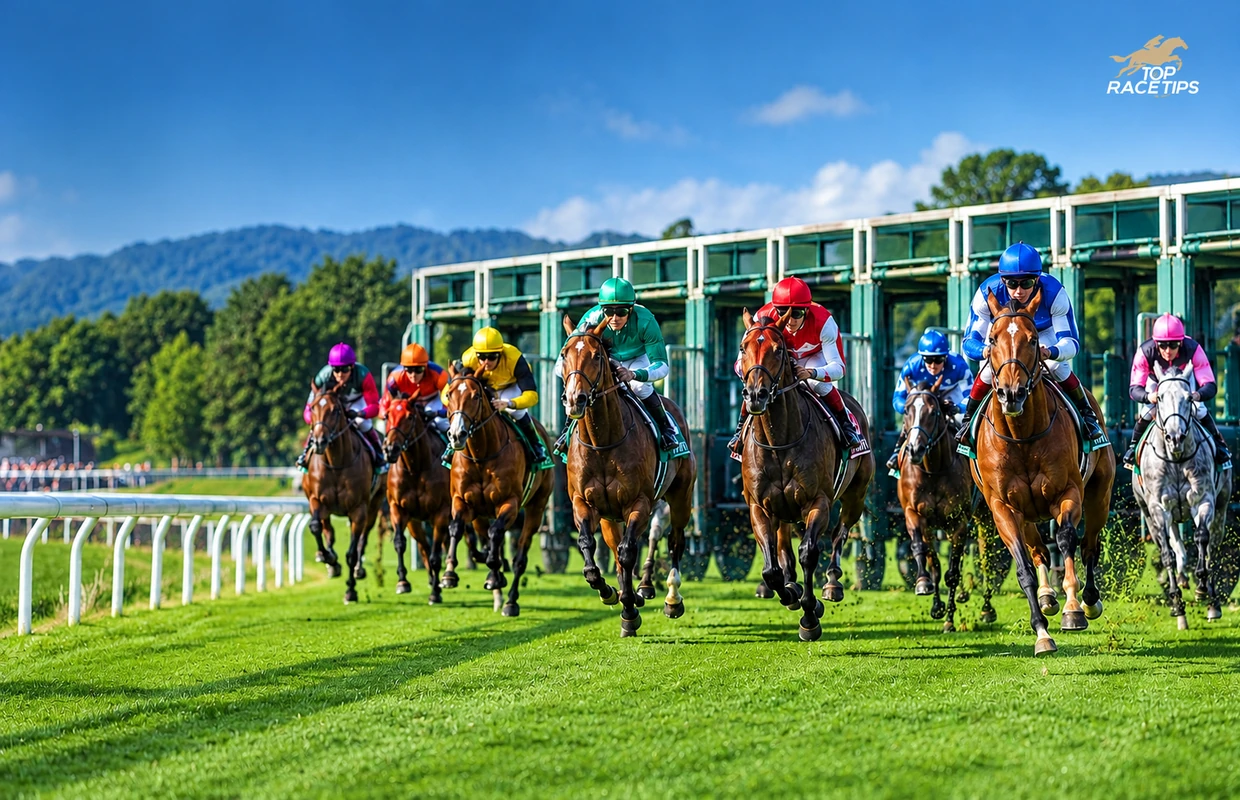
Each flat race starts with the horses in a row of starting stalls. Each horse gets a number, and that number decides its stall. Many fans think it doesn't matter. Yet bias in horse racing is real at some tracks, and it can change who wins.
Draw bias means that some stalls give a horse a better chance than others. The draw is random, so the horse does not choose its stall. But on some courses, the winners come from the same stalls again and again.
Those with lower numbers usually sit on the left. Most jockeys want to stay near the inside rail, as this is the shortest route. So on left-hand tracks, lower numbers often help. On right-hand tracks, higher numbers often help. This is just a general rule, and each track is different.
Think about sprinting in the Olympics. Runners in the outer lanes start from the front, so everyone runs the same distance. All the horses start moving in a single line. So the journey of the horse inside is shorter.
Some sources calculated approximately 12 additional feet on the outside of each stall. Accordingly, a horse in stall 8 can run 96 feet further than a horse in stall 1 on a left-hand track.
Several things change how big the bias is:
Running style also matters. A fast starter in the inside stall can take the lead. In the same stall the slow starter may get stuck on the rail.
Some courses are well known for their bias. Here is what racing data shows.
| Course | What the Data Shows |
| Chester | In 5f and 6f races, almost two-thirds of winners came from stalls 1 to 3. |
| Beverley | Stalls 1 to 4 have a clear edge in short sprints. |
| Catterick | About 14% of races are won from stall 1. |
| Lingfield (Turf, 6f) | In one sample, stall 1 had no winners, while the highest stall won nearly 33%. |
| Kempton (All-Weather) | From 2012 to 2021, 21% of winners came from stall 1. |
| Newcastle (All-Weather) | Half of the winners in big fields came from stalls 10 to 14. |
Chester is the best-known case. It is a tight oval with short straights, so it is hard to pass rivals there.
A bias does not last forever. Ascot was once favoured for a low draw. The track was then rebuilt in 2005, and the siding was mostly gone. Therefore, there is a need to re-examine the old numbers.
Draw bias is a helpful clue, but it's not a magic key. Bookmakers are aware of this and factor it into their bets. Randomly backing a good draw is not a plan. Check course, distance, journey and price. Then think about how the horse likes to run.
Draw Bias in horse racing is a small advantage that can matter in a close contest. It is strongest in fast races, tight tracks and large fields. Use this as one clue among many.
Please bet carefully. You must be 18 or older. Never risk money that you cannot afford to lose.
Draw bias occurs when horses starting from certain stalls have an advantage over others on the racecourse.
Chester is known for its low draw advantage in smaller races. Beverley and some other courses may also show bias.
Stall position can affect the distance a horse runs, its position near the rail, and how easily it can move around other horses.
No, the draw bias depends on the course, race distance, size of the field, ground conditions and each horse's running style.
Check recent draw statistics for course and distance, then consider the horse's form, running style and other race conditions.




Ride with The Best